

Cricket has always been a sport of innovation, changing with the demands of supporters and new technology. For many decades, Test matches were contested during the day and with a traditional red ball. But as the love for cricket spread, and people wanted games they could watch on afternoons after work or school, another problem presented itself. Test cricket required a ball that was visible not just in daylight, but under floodlights. That’s where the pink ball came into play—an innovation that radically altered the Day-Night Test match format forever.
What Is a Pink Ball in Cricket?
A pink cricket ball can appear very much like many other cricket balls; however this is where the similarities end (well, most of them). It is designed specifically to enable Test matches in both day and night. The ball is made of leather and dyed pink, with a special coating to help it remain bright and visible for long match hours. It is also stitched in dark to help with visibility against green pitches and bright floodlights.
The pink ball, unlike the white used in shorter formats and the previous red ball (believed to last 80–45 overs), is expected to be usable for some 80–90 overs. Such toughness is essential to preserve the spirit of Test cricket while also not entirely eroding the balance between bat and ball.
Construction and Design
When the ball has to be durable for many years, a little harder leather is used by the manufacturers. A thick layer of polyurethane coating is used, preserving the shine, and offers swing for fast bowlers. Kookaburra (Australian), Dukes (UK) and SG (India) are some welknown brands who make pink balls from different structures based on local preferences. For instance, the Kookaburra pink starts swinging earlier but the Dukes ball continues to do so even in a few overs.
Why Is Pink Ball Used in Cricket?
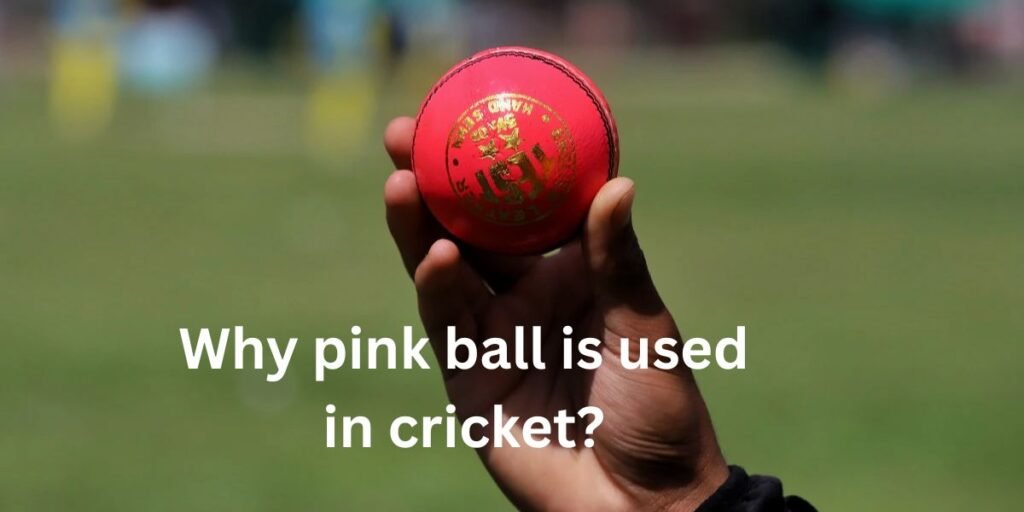
The primary reason for pink was to keep Test matches visible, exciting and crowd-friendly after sunset. So as the old red ball became virtually invisible under lights (or indeed at night on TV), and the white clashed with players’ Test whites, pink provides a solution. Its bright color to be easily seen by the players as well as by spectators.
Better Visibility for Night Cricket
Red balls tend to become one with the gloomy background during dusk or night. Players in particular struggle to pick color red balls when they are fielding or batting under high lights. Thanks to its bright colour and shine coating, the pink ball will hold up in low visibility playing conditions.
Reviving Test Cricket Popularity
Proper daylight Test matches used to leave stadiums looking ’empty’ with travel-oriented modern routines having seeped in everywhere. To lure the working classes, cricket boards began hosting Day-Night Tests whose final sessions are held at night. It resulted in greater viewer interaction, better TV ratings, and more general affection for Test cricket.
More Durable Than White Ball
White balls, although they are visible under lights, discolour and stop swinging after a few overs. Pink balls rectify this problem by remaining harder and shinier for a longer duration. This ensures there is a level playing field and people can challenge the batters even past the halfway of the match!
History of Pink Ball Cricket
It’s an interesting story, the path of the pink ball, and it is rooted in groups wanting to improve Test cricket. Before settling on pink, experts trialed colors including orange and yellow. But no such product could give us the combo we needed between high visibility and durability.
The first significant development came with the announcement from MCC (Marylebone Cricket Club) of formal trials in the 2000s. The pink ball was tested out in county cricket in England, and the results were good. The year 2015 finally saw cricket changing its colours in Adelaide, as Australia and New Zealand battled it out in a Day-Night Test, which was also the first one ever. The match was a success, with large stadium attendance and television viewership around the world.
India became a part of this format in late 2019 when they played their first-ever Day/Night Test against Bangladesh at Eden Gardens, Kolkata. The crowd was electric, and the bowlers took command, signaling a new Indian cricket phase.
How the Pink Ball Plays on the Field
Pink ball cricket has added new dimensions for not just players but also it made Test cricket even more exciting. Unlike the red ball, the pink ball behaves differently according to weather, lights and pitch.
Swing and Seam Movement
One of the most discussed points about the pink ball has been the additional swing that it seems to create, particularly during the twilight evening session. The coating reflects differently as the lights take over and the sun sets, which causes the ball to dance in its own unpredictable way. It is a time dominated by the fast bowler; many wickets go just after evening breaks.
Challenges for Batsmen
The batsmen find it hard to adjust within minutes of playing in the day under natural light and then unnatural light. The ball skid is more and the sighting becomes difficult because of the shine. The firmness of the ball also contributes to sharper bounce in the early stages of a game.
Impact on Spin Bowling
Spinners can be somewhat hindered early in a game because the coating on lightly used balls makes it harder to grip. But once the leather starts to wear, the ball starts gripping and turning big, which is then a huge challenge later in the match.
Significance of Pink Ball Cricket in Contemporary
It was a shift that went beyond the colour of the ball, but it not only concerned changing its hue, but also about securing the future of Test cricket. They are something to play, when everyone is free at evenings and can come out and enjoy the games.
This innovation has so far enabled Test cricket to remain in the game with fast and fun formats like T20s and leagues ruling the world. The appeal of night Tests The fans love the atmosphere that envelops a night Test — with the shiny ball, electric crowd and unpredictability over sessions making for a spectacle that keeps everyone engrossed.
Boosting Cricket Revenue
Night matches ensure more footfalls at grounds and enhance sponsorship. That encourages broadcasters to invest more, which means that the game benefits, financially. It’s a fair contest between bat and ball.
Test cricket is a game of patience and intelligent strategy. Given that the pink ball does different things during day-night Tests, captains and bowlers will need to be cunning with tactics. Twilight demands sharpness from batters and uses of movement for bowlers. This introduces competitive parity, resulting in more compelling games.
Read Also: What is cricket ball weight?
Pink Ball vs Red Ball and White Ball
While all three appear similar in form, they have different functions. The pink ball is a happy compromise between the other two.
| Feature | Pink Ball | Red Ball | White Ball |
| Format | Day-Night Tests | Day Tests | ODIs & T20Is |
| Visibility | Excellent under lights | Excellent in daylight | Excellent with colored kits |
| Durability | Long but affected by dew | Longest durability | Short lifespan |
| Swing Behavior | More in twilight | Stable throughout | Decreases quickly |
Popular Pink-Ball Test Matches
There have been already some iconic encounters that will make the pink ball worth remembering:
- First Day-Night Test 2015 (AUS vs NZ) – A significant moment for cricket
- India’s first Pink-Ball Test, 2019 – Huge fan attendance in Kolkata
- Ashes Series Pink Ball Test – Amazing movement creating so many issues for batters
- Every game has proved how enthralling and unpredictable this format can be.
Final Thought
The arrival of the pink ball is one of cricket’s more intelligent innovations. It is fine for Test match cricket but doesn’t lose the ‘umph’ at all, like so many others do after sundown. By enhancing audience engagement and providing a fresh challenge on the field, the pink ball retains Test cricket’s appeal as well as taking it into the future.
While there are issues like dew and spin limits, continuing research and advancement has made the ball more efficient. What is clear is that the pink ball for day-night Tests has come to represent how cricket has evolved-preserving its Test heritage while embracing a modern viewing experience.
Cricket enthusiasts around the globe today have the pleasure of following exciting Day-Night Tests, with the luminous pink ballly scale creature under floodlights being a symbol of new excitement in world cricket. There are plenty more spectacles still to come as this experiment goes on, keeping Test cricket alive, bigger and stronger than before.