
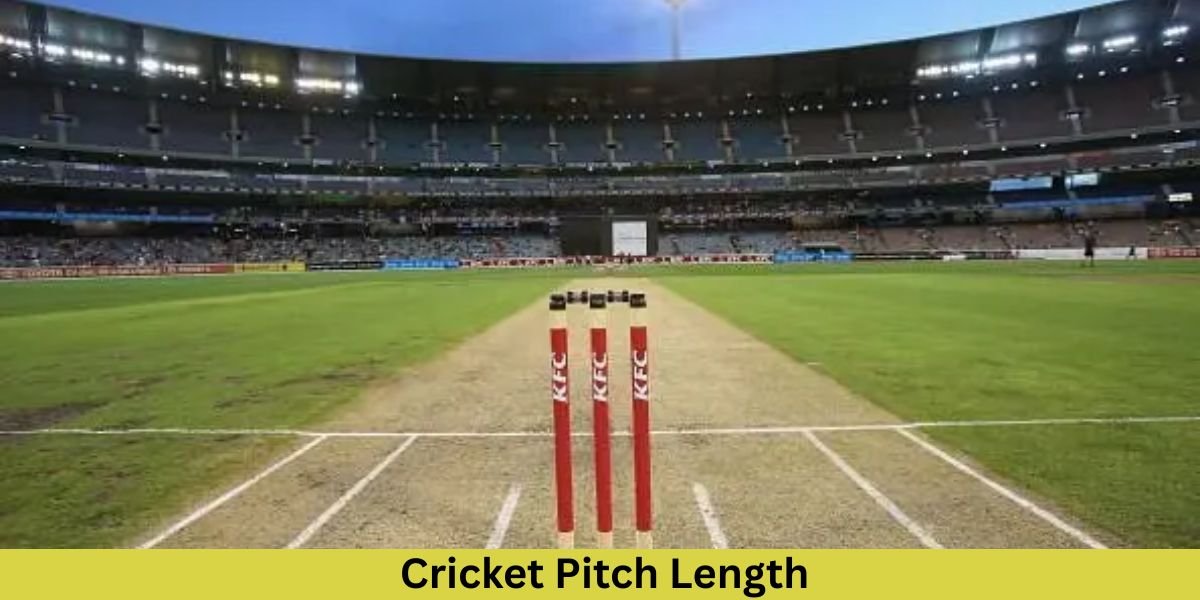
Cricket is a game of fine margins and every small measurement makes the difference between winning and losing. Of all these dimensions, the length of the cricket pitch is perhaps most important, for every ball bowled and struck, or run made or plan devised occurs within the confines of this immutable strip 22 yards long. The cricket pitch is the battleground where bowlers seek to assert themselves with their craft while batsmen look to decipher every ball and counter it with technique and timing. An understanding of pitch length in cricket is useful not only for players and coaches, but also for fans, analysts, writers and young cricketers who are trying to figure out how measurements affect the act of playing. What is cricket pitch length?Cricket pitch good length zone: Ins and rtances This article will cover all the below in one detailed paragraph-based explanation, I hope this should get ranked on Google.
Understanding the Standard Cricket Pitch Length
A cricket pitch has been a standard for centuries, and its size hasn’t changed irrespective of which country or what type game whether it’s at professional level. The standard size of a cricket pitch is twenty-two the length of which is converted into sixty-six feet or 20.12 meters. This distance was established centuries ago in England when the sport of Cricket was developing, and it is maintained for matches around the world because it represents the ideal relationship between bat and ball. The distance is such that fast bowlers can build up a decent momentum at the beginning of their run-up, while batters have enough reaction time to adjust and play according to line and length. This precise length will guarantee fair, consistent and balanced playing conditions which the game of cricket needs to prosper in all formats from tests through to T20 leagues.
Cricket Pitch Length in Feet
Now when it comes to reading how many feet is a cricket pitch this dimension becomes even more graspable for audiences that would like relate distances in the imperial manner. A cricket pitch measures 66 feet from one set of stumps to the other. This measurement accounts for the surface on which the ball rebounds and from where it moves toward the batter. Many people find it easy to visualize the actual distance in the field once they get to know what is a cricket pitch length in feet. Even a “quick” bowler will generate release speeds where the ball travels 66 feet in less than.4 seconds, which really demonstrates an incredible reaction time required by the batsman. The pitch might appear smaller on the television screen due to camera angles, but at sixty-six feet it is a heavy weightage of that four-letter word called “distance” that lends an underlying semblance to the contest between pace, swing, spin and batting technique.
Read Also: Why Pink Ball is Used in Cricket?
Cricket Pitch Length in Meter
For those reading and sporting venues using the metric system, the length of a cricket pitch is formally written as 20.12 metres. This length is in use everywhere in stadiums, cricket academies, indoor training centers and professional match preparation. While it can’t create the actual pitches heard in specific countries (the 20.12 metres have slightly different soil types and pitch behaviour according to the country), the length of 20.12 metres is almost universally consistent.” This very slight deviation from imperial to metric units does not affect the way the game is played; rather, it enables people at sporting authorities around the world to maintain exacting standards when laying pitches. Groundsmen sometimes even have to use proper metric measurements to the millimeter just to make sure the pitch is properly marked/rolled/leveled/cut as per international regulations. This ensures that every ball bowled in Australia, India, England or South Africa and everywhere else travels the identical 20.12 meters before it reaches the batsman.
What Is the Length of a Cricket Pitch?
When someone inquires what the length is of a cricket pitch, and then hears the answer to that question – simple as it may be – he or she is presented with something mind-numbingly fundamental: a cricket field is twenty-two yards long. Within this stretched level area is placed the pitch, a flat surface 3 metres wide, with very short grass that tends to be worn away as the game progresses (cricket grounds in England are usually much softer than in Australia). This precise measurement is nowhere as important as in the way batters gauge length, bowlers assess their run-up and umpires police no-balls, stumpings and run-outs. A pitch either shorter or longer than twenty-two yards and the game would be played in a completely different rhythm. A pitch that is too short would suit the fast bowlers, and one that is too long would torment the batsmen and render bowling impossible. So, it’s important we keep that rule length in place to help maintain the integrity of cricket.
Full Dimensions and Structure of a Cricket Pitch
While the pitch length is often spoken of most, multiple dimensions make up the pitch itself. The region where the ball bounces is ten feet wide, just over three meters. This width provides space for footmarks, turn zones and natural match wear. A cricket field has a pitch with stumps (the two sets of three sticks) and bails at each end, and several circles (including the batsman’s ground (creases) where the bowler delivers the ball). The bowling or popping crease is eight feet eight inches from the wickets, and has three stumps right in the middle. Four feet in front of the bowling creas off is another line drawn, known as popping crease as this helps in deciding run outs and stumpings. The crease marks at both the ends extend into return creases to denote the region behind which (when t ball is delivered), the bowler’s back foot will land. Together, these lines define a fully-controllable playing surface, in conjunction with the pitch length, to help ensure fair play.
Read Also: What is cricket ball weight?
Types of Cricket Pitches and Their Natural Tendencies
Pitch length remains constant but cricket pitches are not all the same as they differ according to the soil type, method of preparation and weather conditions. Some of the pitches are dry and dusty, leading to a lot more turn for spinners. Others are green and grassy, offering the quick bowlers added movement off their seam. Hard pitches also tend to produce steep bounce, particularly in countries like Australia and South Africa where that advantage is naturally exploited by fast bowlers. On the other hand, dead tracks (which have less grass and moisture) often turn into flat batting pitches where it is difficult for bowlers to pick up wickets. These variances can have an effect on how the players approach the game of cricket across the 22 yards, but at its very core the game is tied to that one fixed length pitch. Irrespective of the kind balls that are being bowled, it is the 22 yards that determine how bowlers can set their approach in terms of length and how batters need to make decisions playing forward or back stride.
Understanding the Cricket Pitch Good Length Area
The good length area is one of the most crucial concept in the game of cricket. This is the area of a pitch where it is the most difficult for batsmen to play off the front foot or back because they can’t commit fully to either option. There is the good length area not too full or short at stakes, where the ball does something either jumps awkwardly, moves off the surface or rises unpredictably. The region typically is approximately 6–8 meters away from the batsman’s stumps, but it can differ depending on the pace of the bowler as well as pitch conditions and match situation. Fast bowlers often use the good length to create a deceptive seam movement, being hard to judge line by batsmen. Spinners utilize the same region to generate sharp turn or gentle drift. On a dry turning track, the good length is even more of a menace because it grips and bites. The essence of the whole contest between bat and ball is how successfully a bowler can find this area, how cleanly he can hit it, while how well the batsman can repel balls landing in that region.
Impact of Length on Bowling
Even though the length of the pitch is fixed, bowlers take 22 yards to plot their ball trajectory with millimeter perfection. For fast bowlers, that long stretch is what allows them to work up steam as they head toward the wicket, and then, once the ball has left their hands, it’s on a journey of less than half a second down to the batsman. The distance allows the ball to swing in the air or seam off the pitch, they said. The short balls tend to bounce around a little past the middle of the pitch while the good-length deliveries tend hit closer to 6 or 7 meters. Full-tosses, Yorkers, but full-pitched deliveries tend to land around the batsman’s toes or just short of the popping crease. Every bowler, whether they are of pace or spin, also needs to learn how the ball operates over those 66 feet in order to consistently ruffle batsmen.
Effect of Pitch Length on Batting
Batsmen measure length and select a shot based on the 22-yard distance. As soon as the batsman sees the ball rising out of the bowler’s hand, he must begin to calculate with short? full? good length? A short ball is one the batsman has time to pull or hook; a full-length ball, to drive. The “good length” zone means there can be variation in height to what the batter has to deal with, hence on the spot decision is required by them on landing point. So the length of pitch also effects the footwork, balance, shot selection.And timing to respond. A batsman who learns the 22 yards of reading becomes far more adjusted to pace and spin and swing.
Pitch Length Law in Case of Junior and Box Cricket
In men’s professional cricket, the usual length for a pitch is in the range of 1.06 m (42 inches) to 1.08 m (42 inches), with junior cricket and box crickets also using shorter pitches when teaching younger players. Younger players may not have the strength or technique to play the full distance, so under-11 and under-13 cricket feature pitches of twelve to sixteen yards long. Both the indoor cricket and box cricket modified forms of the sport are played on shorter pitches, often also with significantly shorter boundaries given that it is played indoors. These modifications contribute to a safer, fairer and improved development of skills.
Read Also: Lionel Messi Profile Jersey Number
How Groundsmen Prepare the Standard 22-Yard Pitch
Pitch preparation: Putting up a cricket pitch is an intricate process in itself and is done by professional people who specialize in preparing the pitch for a match before it takes place The ground must be perfectly levelled, rolled with water spread over the surface and then cut before any professional game of cricket begins. The first thing the grounds men do after that is measure out the 22 yards either by a steel tape or laser markers. Once that measurement is plotted, they level the soil so there are no bumps or soft spots. Heavy rollers are rolled again and again to try to make it crust over and have an even bounce. The groundmen mow the grass to the desired height, according to the game format-Keeping thick grass turf for fast bowling or cutting off a more bare surface to help spinners. The pitch is then watered, dried brushed and covered until the match day. Each stride is carried out with a purpose as even an iota of mistake in the 22 yards can change the scenario of a match.
Conclusion
The cricket pitch may look easy, yet the lengths and breadth of the square in particular, at twenty-two yards, frame every aspect and strategy of the game. Sixty-six feet or 20.12 meters is pitch length, on which each delivery bowled and shot played by the batsman thrives. From getting an idea of the good length area to determining how the ball reacts over a 22-yard strip, a pitch has always been at the centre of battles between bat and ball. This detailed piece is about not only measurements, but it also discusses the significance of pitch behavior, the creases role in pitches, how it effect batting and bowling, what international pitches look like and how grounds men work. The cricket pitch has remained the same length but the game played on it is different depending on conditions, skill levels and strategy and that’s why cricket is one of the most interesting sports in the world.